Hollywood’s new creative golden age?: American cinema is at a crossroads: industry strikes, financial pressures, and shifting audience interests threaten to make Hollywood as obsolete as print media or dinosaurs. With theater chains collapsing and audiences flocking to online content, Hollywood continues producing costly flops that fail to attract viewers. Many wonder if movies can survive, as studios struggle even with outside capital. Yet history provides hope.
The industry faced a similar crisis in the 1960s, and what followed was a transformative era—New Hollywood—that revitalized not just American but global culture. Given today’s parallels, this piece will examine whether the current turmoil could start a new golden age for film, as it was in the 1970s, or if fundamental differences make that unlikely. To answer this, we must compare today’s conditions with those of the past. Let’s explore what history—and the present—suggest about Hollywood’s future. With that, let’s see if we are in Hollywood’s new creative golden age.
History Repeats in Hollywood: 1960s
To start, both Hollywood today and in the 1960s faced environments hostile to movies, with waning relevance as alternative entertainment rose. In the 60s, TV and music, especially rock, captured the younger audience’s interests away from theaters. TV provided free, diverse programming, diminishing the exclusivity of theaters, while the recording industry drew in youth with new musical trends. Similarly, today, Hollywood competes with YouTube, TikTok, social media, and video games—all major sources of entertainment that grab audiences’ attention. The increased competition for people’s time has once again challenged Hollywood’s dominance and relevance.
Both the Hollywood of today and of the 1960s had issues that prevented them from getting the attention of consumers. Hollywood in the 1960s was still under the studio system, where studios and the producers controlled the creative process. People like directors or actors had little say in the films they made. Actors even had to sign exclusivity contracts with studios, making them employees of the studio. Studios controlled everything and used their power to create works that could not be shown on television. They created wider screens, made 3d movies, and pulled all sorts of gimmicks to try and get people to care.
Their most successful tactic was emphasizing expensive works, usually being historical epics or musicals. These works were not only in color but had special releases known as roadshow releases. This is where the entire film would first have a limited release, then later be rereleased as a shorter work. This tactic aimed to replicate the feeling of attending a fancy play, and even had programs and other promotional material with the release. This tactic worked well for a while, but the growing costs of these movies started to take a toll. In particular, the expensive disasters of Hello Dolly and Camelot in the late 60s led to this model bottoming out.
Hollywood of today is also in this line of thinking, with similar films and results. Competition from social media, gaming, and streaming, alongside hardship brought about by the financial crisis, has also led to a similar shift in Hollywood. Private equity started getting more influence in Hollywood. With this, profits became more influential for the business, while decisions became less risky. This was exemplified by the rise of movies based on pre-existing franchises, often involving a cinematic universe and high executive meddling. Similar to musicals, this model is also collapsing. Major failures like The Marvels, Blue Beetle, and even franchises like Indiana Jones can’t stop failing at the box office.
Alongside these failures, Hollywood also faces steep competition from foreign and independent films. This is similar to Hollywood in the 1960s. In 1948, the Supreme Court ruled that movie studios could not own theaters, leading to releases no longer monopolized by major players. Smaller studios and international productions could now show in theaters alongside Hollywood films. International films in particular were very popular, with British, Italian, and Japanese films often being more experimental and risky than American films.
In a similar fashion, Hollywood is now competing with foreign and independent films. Independent studios A24 and Blumhouse have been creating some of the best works in recent memory. Meanwhile, audiences are becoming drawn to Korean movies and Japanese anime. Between these similar behaviours and outcomes, history repeats itself in Hollywood’s current situation. There have even been concurrent writers’ and actors’ strikes. So, if the current situation occurs similarly to what happened in the 1960s, what happens after? Well, to find out, we must explore where Hollywood’s situation in the 1960s went.
The New Hollywood Movement Begins
By the end of the 1960s, Hollywood was in a desperate place. Their relevance had slipped significantly since their peak. Audiences, especially baby boomers, couldn’t care less about what came out of Tinseltown. Especially with the rise of TV and rock music. This lack of interest showed in the box office, with financial bombs being common. To make matters worse, both actors and writers went on strike in the late 60s. All the while, the old studio heads were relinquishing their control of their business. Soon, corporations and other entities came in and started buying studios, resulting in new management.
It seemed that with all these issues that Hollywood would soon be doomed to obscurity. Yet, in these chaotic and desperate times, studios did something they had never done before. They decided to give filmmakers more creative freedom than ever before. For one of the rare times in Hollywood history, directors and other creatives had full control of what they made and how they made it. It did not take long for results to show, and they were nothing to scoff at. Hence, it was the start of the New Hollywood movement.
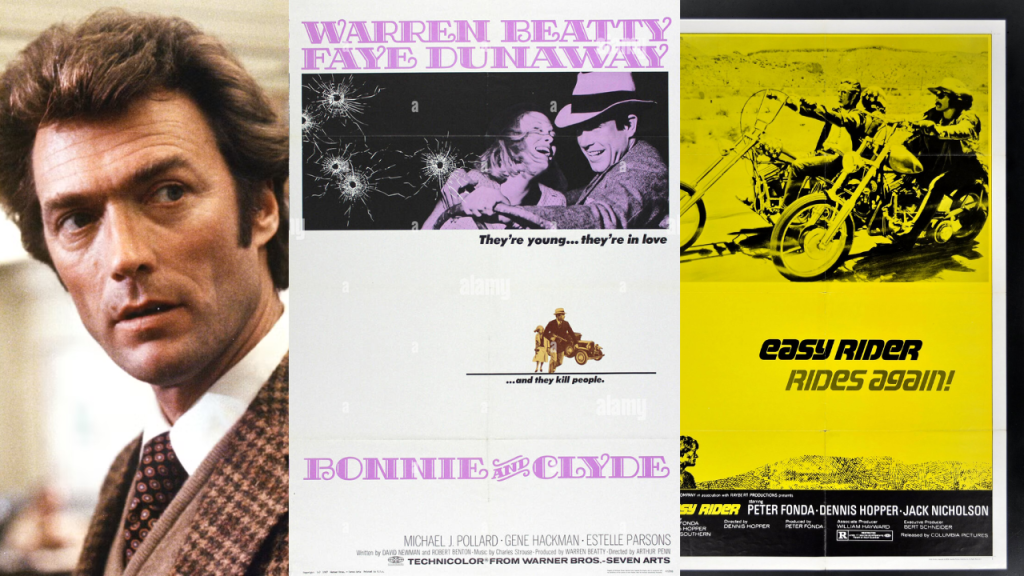
Kicking off in 1967 with films like The Graduate and Bonnie and Clyde, more creatively driven films would take over Hollywood’s output for the next few years. Yet despite how quickly they took over the town’s productions, these films were very different from what had come before. For starters, the subject matter featured would have given Hays Code censors a heart attack. An example of this was Bonnie and Clyde, which was the most violent movie released by Hollywood at that point. Yet it was released uncensored, and by the next year, the outdated code would be replaced by a proper waiting system. Sexual content and nudity were also more prevalent. Works like A Clockwork Orange, for example, would be so rife with sexual subject matter that it was rated X, where the film could only be seen by adults with no leeway.
Yet it was not only the lack of censorship that made the contents of these films different from earlier Hollywood films. It was also the subject matter. The films often dealt with more adult subject matter than before and also covered topics relevant to audiences of the day. This included civil rights, the Vietnam War, second-wave feminism, political corruption, and other issues. Characters were also different from films before. They were morally grey, complex, and could develop over the course of a movie. The most obvious example of the shift was how historical epics were handled between this new Hollywood and the old Hollywood.
Historical epics in old Hollywood were often depicted with obvious good and bad guys, with often no consideration for atrocities or minorities. Yet historical epics in this era’s Hollywood were often gritty and acknowledged the atrocities and perspectives of minorities alongside the historical narrative. This is probably the most obvious example of how much Hollywood films have changed. However, it was not only the subject matter that was different, because almost everything involving films in Hollywood had changed.
This started with the way films were shot. In previous eras, Hollywood films were often shot like the actors were on a stage. It was very rigged, yet in New Hollywood, the camera had more freeform movement. Shots also became more stylized in this era. Steadicam was also invented in this era. This direction for shooting was inspired by both art films and documentaries. This also inspired a major shift in film lighting. Lighting became more naturalistic and reliant on the natural lighting of the set rather than set lights. Acting and writing also changed, with actors (often trained in New York) performing more naturalistically. Meanwhile, writers made movie plots that were more experimental and complex.
Overall, it was an experimental and exciting time for Hollywood with many great works being released. These include MASH, The Godfather, 2001: A Space Odyssey, Night of the Living Dead, Barry Lyndon, Apocalypse Now, Easy Rider, Midnight Cowboy, Dirty Harry, THX 1138, and many more. However, as great as this era was, it was not to last. By the late 1970s, the success of these works allowed directors to undertake bigger, more ambitious, and expensive projects. Some of these works would succeed, like Apocalypse Now. Others, however, would be so costly and fail so hard that they would destroy their studios. United Artists’ Heaven’s Gate was expensive, but it bombed hard at the box office, and only a few years after UA would collapse as well.
Other expensive New Hollywood flops were also released, and executives began to resist supporting any more such films. This attitude was further supported by the rise of the high concept film. They were simple and fantastical films that appealed to mass audiences. They also brought more money into Hollywood than ever before. Soon, studios shifted focus towards films like Rocky, Star Wars, and Superman, and shifted away from the New Hollywood releases. By the early 1980s, the movement was over. Yet in our current day, it seems Hollywood could again be entering a new age of artistic freedom, similar to what it was in the 1960s. Although there are some factors to consider.
Film History Divides
Some of the factors people may want to consider are the choices in other media options then vs now. Back then, outside of movies, the only entertainment options people had were television, books, and music. This was also limited since for TV, you only had a limited number of channels. As well, your music choices amounted to how many acts your local store carried. The same is true for books as well. In this limited environment, it was easy for movies to stand out and gain a footing since there was not much competition otherwise.
However, when it comes to today, there is generally a lot more competition. Not only from books, TV, and music, but video games and the internet as well. The internet in general is a whole other beast, with stuff like social media taking up more time than anything in the past. Video games are also similar in how they often take more time than interests like music as well. The other established competitions are also greatly expanded, with the amount of albums, books, and TV shows a person can see being almost limitless thanks to the internet. That is also not to mention the endless stream of video content available for people to easily consume. All of this strengthened competition puts movies in a poor spot compared to where they were years ago.
There are also other factors that make it more difficult for the industry. Movies are much more expensive to see in theaters. If you combine this fact with others, such as how companies still rely on box office revenue and the rise in competition, it makes this fact sting even more for the industry. There are also the entrenched business interests in the industry to consider when riskier films are being made. Overall, Hollywood is in a less financially forgiving era than before, and the idea of a movement similar to New Hollywood taking place again becomes less believable when considering current factors. It seems that people would rather consume online content and series than be in a theater with others. Although this reality is rather stark, it does not mean that Hollywood, or films, can’t make a comeback.
What the Future Holds
Despite potential hurdles, there are still opportunities for filmmakers to make their mark. Film production, for example, is more accessible to the average joe than ever before. Every phone now has a camera and the ability to download editing software. Although cameras and special effects software for computers are not that expensive, if directors are looking for something a little high end. To add, sites like YouTube have made film distribution much easier. Combined with some marketing knowhow, it allows filmmakers to promote their work to audiences with manageable costs. Funding options are more prevalent with sites like Kickstarter and IndieGoGo.
There are also unique funding options like blockchain and Web3. They allow investors not only to invest, but to vote on production matters and see where their funding goes. There is even support from governments that could provide even more funding for these films. These developments enable anyone with an interest in filmmaking to direct a project. Such was not always possible back in the day, as Hollywood bureaucracy determined who got to make films or not. This development in access to filmmaking can also benefit from a change in audience preference and directing styles. People are getting sick of superhero and franchise slop and want to watch films that are different from the status quo. With that, newer generations of filmmakers are beginning to cater to such demands. More director-driven films, like Sinners, have done very well despite their modest budgets.
Directors have also felt freer to pursue ideas like more lo-fi production and an emphasis on meta. This is coupled by the rise of independent distributors like A24 and Blumhouse, which have been a strong voice towards director-driven cinema. They are also very successful. As well, horror is gaining traction with mainstream audiences, with original works like Sinners and franchises like Final Destination being very successful. These films are often low-budget, and could encourage director-driven work even more. They have also proven to be a good way to get people into theaters, making them more money in the process. Overall, there are still plenty of opportunities for directors to make their works. With the trends currently going on as well, there are also more possibilities for work in the future.
Conclusion
In conclusion, the possibility of a new wave occurring again in Hollywood may occur. Making massive box office bombs over and over again cannot last forever. Hollywood studios will have to cut costs at some point. There are also so many similarities that not to even consider a new wave being a possibility is short-sighted. Although things are not what they were in the past. Hollywood is more bound up and irrelevant than ever, with the rise of other entertainment mediums taking its audience away.
Meanwhile, it is easier than ever for filmmakers to make works for cheap and have them exposed to bigger audiences than ever before. To add, the appetite seems to be more driven by auteur films than any other genre. Regardless of whether Hollywood gets involved or not, the wave is going to happen. It is too easy for people to not make films. So, if you have that feeling of wanting to be a director, don’t hesitate or wait. Now is the perfect time, so get off this article and start creating.
Check out other movie-related blogs on Blu-ray Bros:
Check out our YouTube channel as well:
This insightful analysis highlights Hollywoods recurring cycles, comparing current struggles with the 1960s and the rise of the New Hollywood movement. Its fascinating to see how historical parallels might predict the industrys future, especially with todays intense competition and shifting audience preferences.
I agree. It’s just like history. Everything is in cycles.