
When it comes to Hollywood, there’s no shortage of weird trends. From beach movies in the 2000s to the pulp heroes of the early 90s, bizarre trends are common for Tinseltown. One trend in particular has captured my eye over the past little bit. An odd trend in American animated adventure films that dominated the late 90s and early 2000s. For at that time, major animation studios released animated adventure films which catered to a more male demographic. This started the animated adventure films of the early 2000s.
These works were massive outliers in the history of American animation. Such only seemed possible in the waning years of an animation renaissance. A time when studios were trying to maintain the success that animated films had in the early 90s. Yet many of these films were massive financial failures. They caused their studios to shutter their studios and only became cult classics years later. That begs the question: why? Why did these studios decide to go in this direction? And how did they manage to mess it up so badly? I’ll answer these questions and more as we look into the animated adventure movie trend of the early 2000s.
Animation Comes Back to Theaters
Nowadays, animated films in theatres are as common as superhero movies. There was a time, though, when that was not the case. The 1970s to mid-80s was one of those times. Then, the only animated movies anyone saw on a “regular” basis was Disney. Yet their films could take years between releases. Other animated films were even rarer. Many of them were either imports or counterculture cartoons for adults. Disney also suffered in this period from middling profits, being almost bought up in the early 80s. It was a dire time, but an experimental one at that. Films were a lot more daring. They were willing to use adult language and subject matter to cover the current issues of the day.
It is also where American animated films began to dabble with science fiction and adventure. Films like Heavy Metal and Rock and Rule would explore sci-fi storytelling with an adult audience in mind. Even films aimed at kids such as The Secret of NIMH would dabble in sci-fi. It was also with NIMH that we would begin to see animated movies come back out in a big way. Directed by former Disney animator Don Bluth, NIMH would use older animation techniques akin to classic Disney films. This method was in contrast to the current cheaper techniques modern Disney works used.
As a result, it excelled over anything Disney made since the death of Walt. Its quality and storytelling even competed with the best of Disney. Soon, Don Bluth’s studio would also succeed over Disney in finances. Thanks to a partnership with Steven Spielberg, Don Bluth productions would see massive financial success with An American Tail and The Land Before Time. Disney would soon see success with The Little Mermaid, a smash hit both at the box office and in merchandise. The Little Mermaid would also kickstart a revival in animated features that would last to this day.
However, The Little Mermaid would also create a template for successful movies. Such would soon limit the types of stories these films could portray. Musical films about royalty became a winning formula, and films that deviated were often failures. These included sci-fi and adventure films. As an example, The Rescuers Down Under featured beautiful animation and released a year after The Little Mermaid. Yet it underperformed after a cut in advertising and never quite recovered from it as Disney instead focused on musicals. It was a dead time for sci-fi in American feature animation, and it seemed as if it would be like that forever. Yet forever does not last.
A Change in Animation
After The Little Mermaid, Disney would have a string of major successes in their animated features. This became known as the ‘Disney renaissance’. Films like Beauty and the Beast, Aladdin, and The Lion King would rake up as much box office success as critical success. They would rake in both tons of merch money and academy awards. Disney’s success, alongside Bluth’s efforts, would also spark Hollywood’s interest in animation. Soon, every major studio was making their own animation division to compete. Fox had Fox Animation, Universal had Amblin Animation, and Warner had Warner Animation. There was even DreamWorks, whose sole purpose seemed to spite Disney.
As these studios were developing, however, the Disney Renaissance had already reached its peak. The Lion King would be the most successful movie of this era, with Disney’s later animated musicals never managing to gain its earlier financial successes. Other studios tried to make similar films to mimic Disney’s success. Yet films like Anastasia and Quest for Camelot never made the big splash like those Disney films did. Audiences now didn’t seem to care as much about animated films as they used to. Movies were bombing all the time, and the formula for animated films looked nonsensical now. It soon became clear to studios that if they were to survive, they would have to change course. They needed to adapt, or die.
This animated action-adventure movie phenomenon of the early 2000s is not a trend talked about much online. Research is mostly limited to articles on the films themselves. There are also only a handful of online forum posts even recognizing the trend from my research. Due to this, there are not a lot of clear answers about why the trend happened as a whole. However, there are some indicators for potential reasons. One of them was a desire to do things differently and experiment from what came before. Most animated feature films released at that time had been musicals.
With any trend like this, if it goes on for long enough, people will get sick of it. Animators must also have been feeling the same way. The directors of Atlantis: The Lost Empire (who also directed Beauty and the Beast and The Hunchback of Notre Dame) admitted that they were sick of directing “Fantasyland” movies and wanted to make “Adventureland” films. DreamWorks also prided itself on making animated movies that were different from Disney. They even made a point about how the characters in The Prince of Egypt looked different from Disney characters. There was a desire for change present.
Yet why did they decide to make animated adventure films instead of doing other genres? It may have something to do with demographics and business. Firstly, the animation industry is very male, with over 71% of animators identifying as men (check link at the bottom). With this stat, it may seem that after years of making animated musicals, they would want to do genres that appealed to their gender more. There was also the threat of genre exhaustion brought about by the glut of animated films at the time. Not only did you have films from all the major studios, but you also had direct-to-video animated movies to contend with. With most of these films being similar, you can see why people would get tired of these films dealing with the same genres as everyone else.
Of course, when this happens, the money does not flow like it used to. So there’s financial pressure to do these films if it means continuing the money flow and expanding the audience. There may have been other external factors at play. A decade before saw sci-fi and adventure films get releasing regularly by Hollywood. So there could have been an effort to capture some 80s nostalgia with these films. There was also the influx of anime in the late 90s. They offered more action-packed adventurous affairs than what American studios were then making. Whatever the factors may be, adventure films would become the next big focus for these studios. Soon, major investments in this genre would also start arriving.
The Difficult Adventure Ahead
When I say major investment, I mean MAJOR. Many of these films were massive financial risks that did things that were rarely done in animation at that point. Atlantis, for example, used a 35mm anamorphic film and had the creator of Hellboy fame design the characters. Factors like these caused budgets to balloon. CGI was also used in these movies more than ever, with Sinbad almost being a hybrid CG-2D film.
As one can imagine, this did not make things cheap. Treasure Planet cost $140 million to produce, The Iron Giant cost $50 million, and many of these other films were no small financial investment. Although it was not only in financing that these films got big investments. After all, many of these films aimed to be big franchises. They would have sequels, cartoons, theme park attractions, and tons of merchandise. So it was also in the best interests of executives to get involved and meddle when they could, and meddle they did.
As an example, both of Dreamwork’s entries into the genre were changed to be much more kid-friendly than intended. This situation happened with El-Dorado, which had a PG-13 rating but became a PG film due to execs wanting a bigger audience. Sinbad was also no exception, having many scenes toned down to better fit families. Of course, executive meddling can destroy creativity and bring down the quality of a film. Such can have bad results. This meddling, alongside the budgets, already proved troublesome for the productions and studios involved. Yet nothing could compare to the greatest burden: marketing. Many of these films had terrible marketing, with some being particularly atrocious. Many of the films had strange aspects marketed that did not reflect what the film was actually about.
El Dorado was one example. Instead of focusing on the comedic elements of the film, marketers focused on how much research the team did on Meso-American civilization. It did not cater to the kinds of people interested in watching a fun adventure film like El Dorado. Titan AE also suffered from marketing aimed at kids despite the mature aspects of the film. However, the film that dealt with the worst marketing was, by far, The Iron Giant. The marketing campaign started only 4 months away from the release and was very limited. It resulted in little exposure of the film upon its arrival. It’s one of the worst marketing snafus in the history of Hollywood, and a testament to how mismanaged animation was at that time.
With these three issues being out of the way, it came time for the films’ release, and it was not good. Most ended up as major financial disasters for the studios. Both Atlantis and Treasure Planet were box office bombs. Planet only grossed $109 million on a $140 million budget (not counting money for marketing, which could have doubled the budget). The Iron Giant debuted at number 9, and Sinbad was such a disaster that the head of DreamWorks proclaimed that 2D animation was dead.
Of course, with such failure, there were bound to be reasons for why such catastrophes happened. Marketing can be a factor, but another issue was also the timing of their releases. Both Atlantis and Treasure Planet released around when other, more successful films released. Atlantis was released between more successful animated films like Shrek and Monsters Inc. Treasure Planet also released alongside the second Harry Potter movie at the height of Potter-mania. Hence, the film had its presence obscured by a wide margin.
Regardless of the reason, however, these films did not do well, and most of the studios who made the films would not last far past them. Warner Animation closed after their last film, 5 years after Iron Giant was released. Fox Animation closed after Titan, and DreamWorks shut down their 2D division after Sinbad. Finally, Disney pivoted their animation division to 3D only a couple of years after Treasure Planet. It seemed as though these movies not only took their company’s money but also their division. Such would change American animation forever in the process. 2D theatrical animation in America was all gone, and it was thanks to only a handful of films.
The Animated Treasures That Await
Despite this destruction, many of the films still managed to live on. Over the years, some of these films have even become cult classics beloved by many. So to know what the fuss is about, I decided to watch some of these films to see what captivates people. Here are my findings:
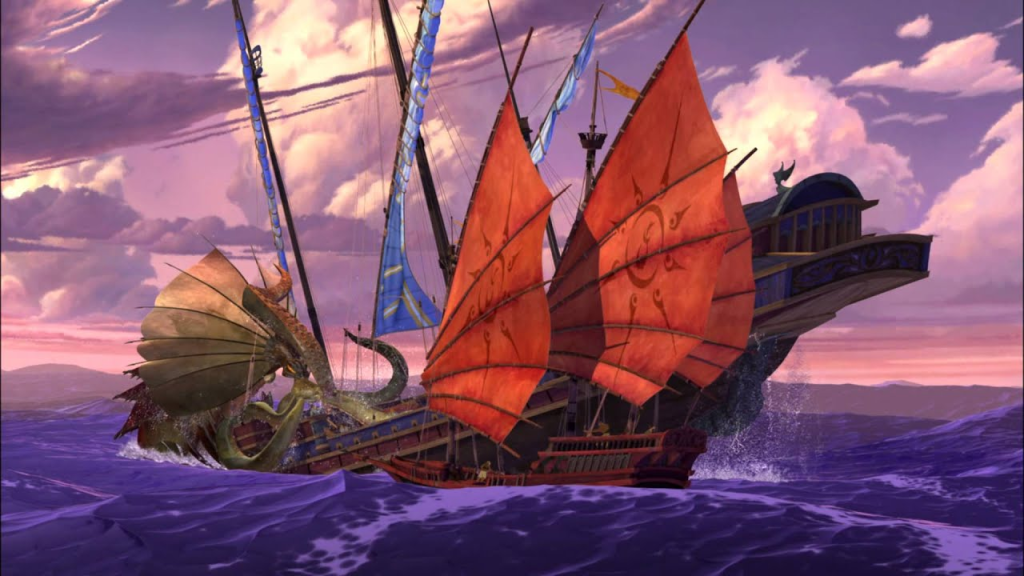
Sinbad: Legend of the Seven Seas
Sinbad is a good movie, but not a remarkable one. The characters are what you expect for such a swash-buckling epic. The story is also pretty standard as well. There’s some chemistry between three of the main characters that add some interest. Yet it is not remarkable. The 2D animation is great, and the CG looks a little dated but it does not hinder the film too much. Yet the biggest problem with this film is not the CG, but the memorability.
There’s nothing unique about the story that people can latch onto and get a strong connection from. It is by the numbers, but that does not mean it’s all bad. It’s fun, short, and does not overstay its welcome like other animated films. Overall, it’s a recommendation if you’re looking for something fun and easy to watch. If you’re looking for something more thorough, you might find disappointment. If not, then go ahead and buy it for yourself:
Treasure Planet
Treasure Planet is a fun and creative movie I wish had lasted longer. The world that they established in this film was interesting. Yet I felt the world could have been expanded out more to make up for some of the strange, nonsensical elements. The characters are standard for this type of film. Yet what makes this film stand out for me compared to Atlantis is the bond between the boy and Long John Silver. It’s such a captivating premise and elevates the film over many other works I have seen. As a whole, it’s a pretty decent space pirate film with some interesting concepts. Yet, it seems to lack polish or a consistent element to push it over into greatness. Still worth checking out though:
Atlantis: The Lost Empire
This movie has a decent premise and some fun ideas, but it felt a little half-baked. There was not much about the film that felt particularly unique compared to a film within its genre. Although some interesting concepts were present. I also felt it was too rushed and skipped out on character development and world-building. I felt that decision could have fleshed out the movie and made it better. It did not need much, just a half hour to get audiences more attached to the story. In conclusion, it was a decent movie and still fun to watch. Yet, I felt it had the potential to be better if it took its time and did more original concepts. Still recommend watching it if you’re interested:
The Iron Giant
Out of all the movies I’ve seen in this category, this was the best one. That is funny, as its premise, in contrast to the other films, is simple. Yet despite such a one-note concept as a giant robot friend, the Iron Giant manages to make it compelling. This is thanks to its engaging characters, direction, and heartwarming story about a weapon who only wants to live in peace. While it may hit its message on your head a bit more than you would like, it makes it up to you by being so solid. Overall, a great movie, and a high recommendation:
Conclusion
Looking back at all the research I’ve done, I can see why audiences may have not been enthusiastic about these films. Many of them seem under-baked and lack a lot of the magic that makes the films they try to ape so compelling. They have their qualities, and sprouts of genius, but those moments feel like islands in a sea of mediocrity. They also seem chained somewhat in their stories, possibly due to them being animated fare. Had these films had longer runtimes and less meddling, they may have turned out great.
In conclusion, what people can learn from this trend are many things. Whether to not bet anything to be a major franchise, or to let creatives be, it could be many things. Aspects which I hope more studios take heed of in the future. This is relevant as more experimental projects come out and such situations occur again. Take heed.
Here is the website for the male animator statistic:
percentage of make animators in american animation in 2000 – Search
Check out other great articles from Blu-ray Bros:
How 90s Cinema was Dominated by Pulp Heroes – Blu-ray Bros.